- -
- Interviews of, and Articles about, Sonia
Interviews of, Articles about, and Books that Include Sonia
Articles about Sonia are also contained in the section on Belgium.
- On December 27, 2022, the Lakewood Ranch (adjacent to Sarasota, FL) Jewish Club mailed its latest newsletter to members, containing the following statements about Sonia.
Sonia Pressman Fuentes, Resident
I am a resident of Kobernick House at Aviva. Today when I went to have lunch in our dining room, members of your club were there to assist and serve us. All your members were most gracious and helpful, and I wanted to express my appreciation. I am the author of a memoir written with humor. If any of your members would like a copy of the ebook edition, I'd be happy to email it to them. I can be reached at cmrflsolutions@gmail.com. (My website is at www.erraticimpact.com/fuentes).
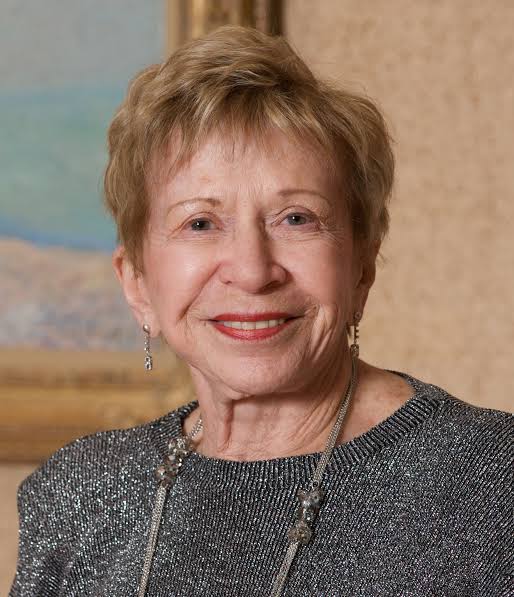 Sonia Fuentes was born in Berlin in 1928. She and her family fled to America in 1933 to escape the Holocaust. Her memoir reveals how a 5-year-old immigrant grew up to be a trailblazer: the first woman attorney in the Office of the General Counsel at the Equal Employment Opportunity Commission (EEOC) in 1965, one of the founders of the National Organization for Women (NOW) in 1966, the highest-paid woman at the headquarters of two multinational corporations: GTE and TRW, and an international speaker on women's rights for the US Information Agency. Today, at 94, she has agreed to make available to us her memoir, Eat First -- You Don't Know What They'll Give You: The Adventures of an Immigrant Family and Their Feminist Daughter.
- On Aug. 29, 2029, the subject of the Yiddish Book Center’s newsletter was “Returning to Our Roots.” The newsletter featured seven interviews from its Oral History Project on that subject, the second of which involved Sonia. She was thrilled to follow Leonard Nimoy’s interview.
- Annette Bethel, a feminist on Sonia’s worldwide feminist email list, sent her on August 14, 2022, the minutes from the NOW 1967 conference that she came across in doing research.
A reference to Sonia is at the end of the write-up, as follows:
“The meeting then had a talk on job discrimination. Aileen Hernandez, a past employee of the EEOC (Equal Employment Opportunity Commission) introduced Sonia Pressman, a present employee of the EEOC, to talk on the subject of the action a woman can take against job discrimination and what part the EEOC takes in the case. Sonia Pressman briefly outlined what Title 7 covers, explaining that federal law in most cases conflict with state protective laws. Employers can not run segregated job ads in the papers. Insurance benefits must be equal for both men and women. AN employer can not refuse to employ a married women. There are many court cases resulting from Title 7; many more cases than were expected when the word sex was added to the Civil Rights act. Sonia Pressman then reviewed the legal procedures one should take in discrimination cases.”
Copyright © 2022 by Thomas Dublin, Kathryn Kish Sklar, Judy Tzu-Chun Wu, Rebecca Jo Plant and Alexander Street, a ProQuest Company
-
On April 19, 2022, Penguin Random House published The Great Stewardess Rebellion: How Women Launched a Workplace Revolution at 30,000 Feet by Nell McShane Wulfhart, in which Sonia plays a prominent part.
In 1968, many U.S. airlines terminated or grounded stewardesses (who flew only on domestic flights) when they married or turned 32 or 35. U.S. airlines also had other requirements and restrictions on these women flight cabin attendants that they did not have on male flight cabin attendants who flew on international flights, were called pursers, and did the same jobs as the stewardesses. Many stewardesses and their union filed complaints with the Equal Employment Opportunity Commission (EEOC) about these practices.
Sonia drafted the decision wherein the EEOC found that the airlines’ policies on age and marriage for stewardesses violated Title VII of the Civil Rights Act of 1964. That decision was later confirmed by the courts. It was the beginning of the legal revolution in women’s rights in the U.S., which later spread worldwide.
The book received outstanding reviews from the Wall Street Journal, The New York Times, and many other publications. Nell McShane Wulfhart discussed the book on radio station WHYY, an NPR affiliate, in Philadelphia, on May 3, 2022, at 10 a.m. on Radio Times. You can hear her comments, including a reference to Sonia, here. (When you get to this website, click on “Listen 49:29” at the top.)
Sonia is mentioned in the Publishers Weekly Jan. 27, 2022, pre-publication review of the book as one of a trio of women who spearheaded the fight. (Read the review.)
The Washington Post selected this book as one of the 50 top nonfiction books of 2022. (Read the article.)
- On Aug. 26, 2021, Growing Bolder, an organization for and about seniors, put an article about Sonia on its website.
- On Aug. 14, 2020, SRQ magazine in Sarasota had an article about Sonia by Andrew Fabian entitled "Foot Soldier for Women's Rights Retells Stories From the Front Lines."
- On July 24, 2020, there was an article in Sarasota Magazine by Kay Kipling about Sarasota's celebration of the centennial of suffrage, which mentioned Sonia twice.
- Article in Town and Country magazine of April 19, 2020, about the history of the ERA begins with a quote from Sonia.
- On Apr. 2, 2019, author Pamela S. Nadell's book, America's Jewish Women: A History From Colonial Times to Today, was published. Ms. Nadell interviewed Sonia for the book, and Sonia is included in it. The New York Times' Mar. 29, 2019, review of the book included the following statement: "From Betty Friedan to Sonia Pressman, Bella Abzug and Gerda Lerner, Jewish women had an outsize role in the feminist struggle."
- The November 30, 2018, issue of the Washington Post contained a column by Petula Dvorak about the ERA and Sonia's comments on it.
- In its October 2018 issue, Sarasota's newspaper, West Coast Woman, announced Sonia's Oct. 24, 2018, talk to the Sarasota chapter of AAUW.
- The Washington Post has a newsletter that explores identity and culture in America called About US, which included Sonia on July 13, 2018.
- On Dec. 20, 2017, Sonia was featured on the cover of the Sarasota section of the Sarasota Herald-Tribune with regard to her talk scheduled for Jan. 11, 2018, to the Ladybugs, the Sarasota chapter of the Ninety-Nines, an international organization of women pilots founded in 1929. The local chapter was founded a year ago.
- From Nov. 9 through 11, 2017, the Sarasota Herald-Tribune's website contained the following article about a talk Sonia was due to deliver at the first anniversary of the Sarasota chapter of the Ninety-Nines, an international organization of female aviators that was founded in 1929.
- In the Jewish Women's Archive blog of July 27, 2017, in the entry, "Combatting Sexual Harassment and Assault in Schools," by Sara Lebow, Esther Warkov, co-founder and co-executive director of SSAIS (Stop Sexual Assault in Schools), refers to Sonia as a senior mentor and a "distinguished feminist lawyer."
- On July 1, 2017, SSAIS (Stop Sexual Assault in Schools) issued its Final Report on its action under an AAUW Community Action Grant Awarded to Stop Sexual Assault in Schools 2016-2017. Sonia is one of seven women quoted at the beginning of the report, as follows:
Two of the critical areas in gender discrimination today are sexual harassment and sexual assault. Most of the attention has, however, been focused on college and university campuses. SSAIS is performing a vital service in fighting sexual harassment and assault in an otherwise forgotten area: K-12. “Sexual Harassment: Not in Our School!,” using experts and student activists, sets forth the applicable law in this area and suggests ways in which families, students, school administrators, faculty, and the community can fight this scourge in grades K-12. -Sonia Pressman Fuentes, attorney, co-founder National Organization for Women
- Sonia in Jewish Women's Archive quiz.
- On Mar. 1, 2017, in its blog, the Jewish Women's Archive for Women's History Month recognized Jewish women lawyers and researchers of second wave feminism, of whom Sonia was one.
- Minnah Stein, a 16-year-old student at Sarasota's Pine View School for the gifted, mentions Sonia in her blog post about the Violins of Hope program brought to Sarasota by the Jewish Federation of Sarasota-Manatee. Minnah's picture is at the end of her post.
- On Jan. 26, 2017, Sonia's friend and mentee, Minnah Stein, a 16-year-old student at Sarasota's Pine View School for the gifted, blogged about Sonia's escape from Nazi Germany in 1933.
- Sixteen-year-old feminist activist and fighter against sexual assaults in schools, Minnah Stein, describes participating in the Women's March (attended by 10,000) in Sarasota, FL and dedicates her first picture to Sonia.
- In connection with the 50th anniversary of the founding of NOW, the Fall 2016 issue of Beacon, the bi-annual magazine, in hard cover and online, of the National Museum of American Jewish History in Philadelphia, PA, included a profile of Sonia called "Founding (Jewish) Mother." Click the arrow at the right of the magazine cover until you come to page 4. To enlarge the print, click on the icon of the open square box to the right of the sliders that are at the bottom of page 4. To leave the page, click "Esc" on your keyboard.
- Sonia was profiled in the May/June 2016 issue of Suncoast Living Magazine, a magazine for people on Florida's West Coast.
- Sonia is included among six women highlighted by the National Women's History Project on Mar. 1, 2016.
- On Feb. 29, 2016, the Veteran Feminists of America, published an ebook of biographies and pictures called Our Fabulous Feminists, which includes Sonia. It can be downloaded for free.
- This picture of Sonia appears on page 36 of the Summer 2015 magazine, Jewish Currents, a progressive, secular voice, as part of an article called “The Jewish Left: A Visual History, Part Two: 1946-2015,” written by the editorial board of that magazine.
- On July 24, 2015, Zoe Nicholson, a feminist activist who is specializing in Alice Paul, sent out an enewsletter, which contained the following about Sonia:
"When I began to study Alice Paul to the exclusion of everything else I realized that phone interviews would be pivotal and rare options. Miss Paul was 92 when she died in 1977 and those who knew her, interned for her or worked for her hold priceless memories that need to be harvested.
"I made calls. Some were emotional. Some were poetic and nostalgic. Of course some were all about politics. But then I made a call that set my sails; it was with Sonia Fuentes. I can still hear her impatience and disgust that most do not know the brilliant strategist mind, the lifelong commitment, the legislation and international impact of Miss Alice Paul. I felt challenged and dug deeper than I had previously planned."
- An article about Sonia in the Winter 2015 issue of Gravitas, an online and hard copy magazine that focuses on women in the Sarasota and Tampa, FL areas.
- In March 2015, Sonia's story went on the website of Just Do Your Dream. To access it:
- Go to justdoyourdream.com,
- click on the drop down menu under "Stories" at the top,
- select "Speaking, Coaching, Teaching," and
- scroll down to Sonia's story when you reach that screen.
- See references to Sonia on the blog of Candy Dawson, the wife of Greg Dawson, author of Hiding in the Spotlight (March 1, 2015).
- Sonia is quoted in a Sarasota Herald-Tribune article of Nov. 5, 2014, about the political campaign for Congress of her 101-year-old friend, Joe Newman.
- Announcement of Sonia's interview on radio station WBAI in program commemorating the 50th anniversary of the passage of Title VII of the Civil Rights Act of 1964, which, among other things, prohibits gender discrimination in employment by covered employers, employment agencies, and labor unions.
- The Jewish News of Sarasota-Manatee, Vol. 44, No. 6 (June 2014, p. 10).
- Excerpt from the June 5, 2014, "Jewdayo" section of Jewish Currents.
- Sonia participates in a Holocaust Survivors program at the Al Katz Center for Holocaust Survivors and Jewish Learning in Sarasota, FL. Front-page article, Bradenton Herald-Tribune, April 28, 2014.
- Dec. 2013 Newsletter of the E.B. Crawford Public Library in Monticello, NY, to which Sonia’s publisher, Xlibris Corp., donated a copy of her memoir.
- Danielle (DanYang) Yu Interviews Trailblazing Feminists, November 7, 2013.
- Xlibris, the publisher of Sonia’s memoir, featured her in its Author Spotlight in November 2013, and also published this article in its November newsletter.
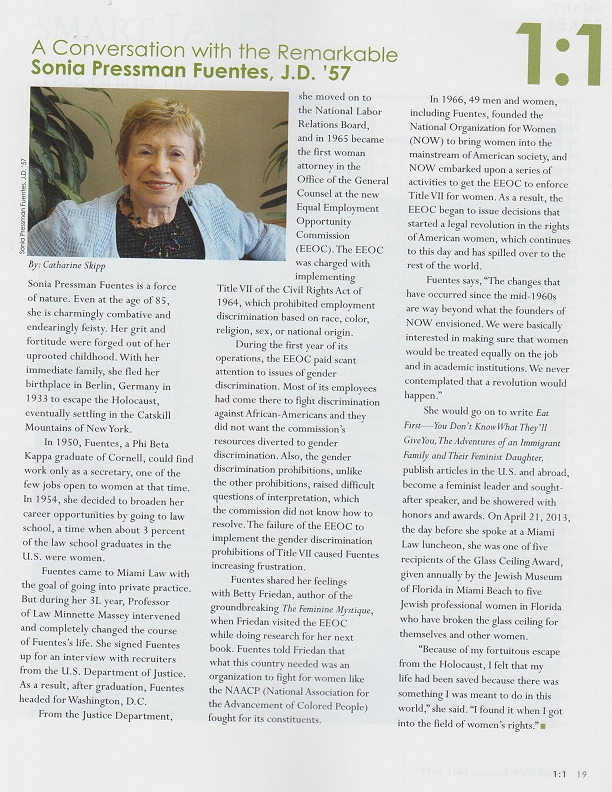
- By Catharine Skipp, "A Conversation with the Remarkable Sonia Pressman Fuentes, J.D. '57," Miami Law Magazine, University of Miami School of Law, Fall 2013. (If you need to enlarge the text to read it in your browser, click on it with your mouse.)
- Jewish Women’s Archive, This Week in History, Week of July 1, 2013, recognizes Sonia’s work at the EEOC on the anniversary of the opening of the EEOC.
- June 13, 2013, Report of Leita Kaldi, head of the UN Women’s Book Club, Sarasota, FL, on the discussion of Sonia’s memoir, with Sonia present, on June 10.
- Sarasota's Sonia Pressman Fuentes to Receive Breaking the Glass Ceiling Award, April 17, 2013.
- On March 14, 2013, the Veteran Feminists of America (VFA), an organization dedicated to recognizing the pioneer feminists of the second wave of the women’s movement, announced the revamping of its website at www.vfa.us. Sonia is mentioned throughout the website.
- On February 21, 2013, the Women’s Herstory Initiative, Words of Women, International Women’s Day, based in Dallas, TX, announced that the essay of seventeen-year-old Talia Weisberg about Sonia on the subject “The Most Influential Woman in My Life” won the Words of Women Essay contest.
- The book, Jews of Sarasota-Manatee, by Kim Sheintal (Arcadia Publishing, Feb. 2013), contains a 2002 photo of Sonia in front of a sign about the Jewish Genealogical Society (JGS) of Southwest Florida (p. 25). Sonia gave a talk to JGS on March 2002. The link will open to page 25.
- “Boston Commons,” by Talia Weisberg, was published on January 8, 2013, in Fresh ink for Teens, an online newspaper sponsored by the Jewish Week in New York City.
- "Groundbreakers or Ground Takers?" by Talia Weisberg, was published on December. 8, 2012, in Fresh ink for Teens, an online publication sponsored by the New York Jewish Week.
- By Tyler Whitson, "Women's Rights Pioneers Strive to Influence and Inspire a New Generation," Sarasota News Leader, November 16, 2012. (Visit the Sarasota News Leader Web site.)
- "Women's Rights Pioneer Sonia Fuentes Speaks at Law School," enewsletter of the Cornell University School of Law, Oct. 31, 2012.
- By Deborah Carney, "Sonia Pressman Fuentes Interview About Feminism and Her Memoir," October 8, 2012.
- Interview with Sonia Pressman Fuentes as a Featured Writer on authormepro.com, August 30, 2012.
- By Nick Friedman, "Neighbors: Sonia Pressman Fuentes," July 4, 2012.
- Sonia is mentioned in an article commemorating the 46th anniversary of the June 1966 founding meeting of NOW. (Jewdayo section of Jewish Currents, June 30, 2012)
- Sarasota Observer, June 28, 2012: Sonia presents copies of her memoir to prizewinning young women students at Booker Middle School, Sarasota, FL.
- RTIRonline asks Sonia to comment on the death of Nora Ephron, June 28, 2012.
- Is Laura Bush feminist enough for Alice Paul Award?, Washington Post, June 20, 2012.
- Sewall-Belmont House draws fire for honoring Laura Bush, Washington, DC's The Examiner, June 20, 2012.
- Who Will Speak Out Against an Outrageous Insult to Former First Lady Laura Bush?, The Huffington Post, June 18, 2012. It says at the end of the article "Continue reading" but we don't have access to any additional material.
- Laura Bush's fight for women, Washington Post, June 19, 2012.
- Sonia initiates campaign to protest the National Woman’s Party/Sewall-Belmont House & Museum’s plan to give the Alice Award to Laura Bush, Washington Post, June 18, 2012.
- Cary Franklin, “Inventing the `traditional concept’ of sex discrimination,” Harv. Law Review, Vol. 125, # 6, p. 1307 (2012), Univ. of Texas Law, Public Law Research Paper #219.
- "Eva Alexandra Countess Kendeffy, Sonia Pressman Fuentes and Rabbi Jonathan Katz", Longboat Key Observer of March 11, 2012. This picture also appeared in the Sarasota, FL, Jewish News (April 2012, p. 14B).
- By David Beard and Bethonie Butler, "The keys to a better life? Everyone has an opinion," February 21, 2012.
- Interview of Sonia by Talia bat Pessi, a high school student, that went online on Feb. 9, 2012. (Note from Sonia: I thought my talk about Colleen Boland had been recorded and was available but it was not.)
- Feb. 5, 2012, Interview with Cyrus Webb, editor of Conversations Magazine.
- "Jean Faust, First President of the First Chapter of NOW," December 8, 2011.
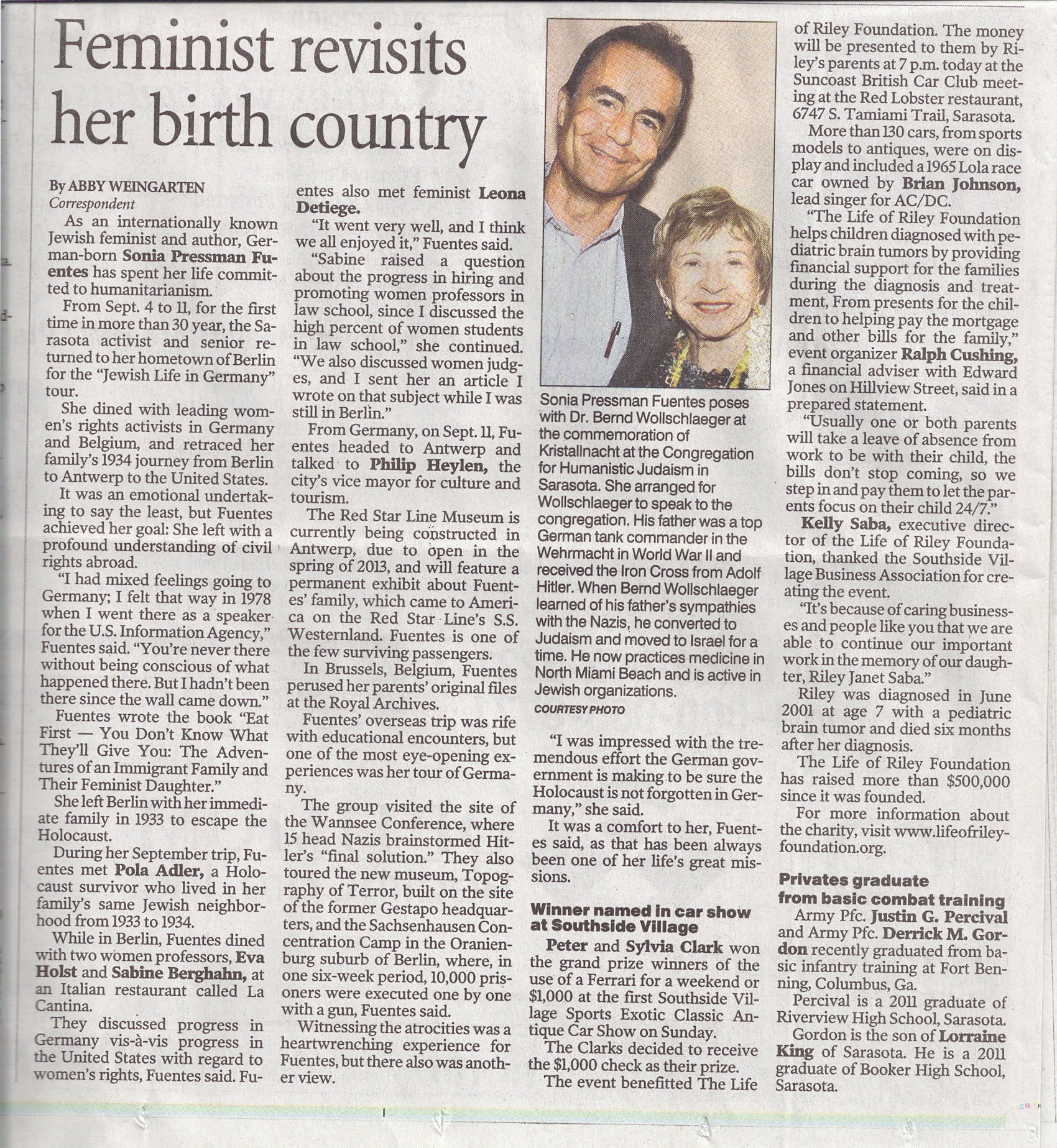
- By Abby Weingarten, "Feminist Revisits Her Birth Country," November 9, 2011 (Online version | Photocopy)/Sonia with Dr. Bernd Wollschlaeger.
- Generations of the Shoah International Newsletter, October 2011.
- "NOW Conference: Action, Inspiration and Connection," Now National Times, Fall 2011.
- "Sonia Fuentes, writer, speaker, and feminist activist, tells us about her life," HavaMAG Life, Issue 4, September 2011. (To access the article: Click on the arrow to the right until it takes you to the Table of Contents on the left. Next, click on the first item in the Table of Contents, which is the article about Sonia, on page 10. When you come to the article, double click on each page to make the type readable.)
- "Featured Author," Published by Sonia's publisher, Xlibris Corp., in a newsletter and on its website, July 27, 2011.
- By Slavica Monczka, "Feminist Sonia Pressman Fuentes. Her Passion for Women's Rights," appeared in the e-zine, Inspirational Woman's Magazine, on July 24, 2011, and was written by Slavica Monczka.
- On July 21, 2011, Amanda Gonzalez wrote an article about Sonia for the blog of Ms. JD, an e-zine targeted to women law students and beginning women lawyers.
- By Slavica Monczka, "Something Beautiful is Happening," seductivelyfrench.com, July 5, 2011.
- "Blending motherhood and working: Moms work by choice — and also out of necessity," Deseret News, June 26, 2011.
- "Second Wave Founder" by Sonia Fuentes, girlscantwhat.com, June 9, 2011.
- The CHJ Connection (Vo. XIV, No. 9, May-June 2011).
- Sonia’s March 3, 2011, letter to the editor of the Sarasota Herald-Tribune is discussed in “Religious Rehab at Florida Jail Sparks Protest,” Church & State (Vol. 64, No. 4, Apr. 2011), the magazine of Americans United for Separation of Church and State. The letter is included and can be read in the Letters to the Editor section of this website.
- The CHJ Connection, the newsletter of the Congregation for Humanistic Judaism in Sarasota, FL, December 2010.
- TILES, the newsletter of the Jewish Museum of Florida, December 2010.
- The Quotable Woman, The First 5,000 Years (6th ed., October 2010), an anthology by Elaine Partnow, includes three quotations from Sonia.
- By WomensRadio Staff, October 12, 2010.
- By Cathy B Stucker, sellingbooks.com, September 8, 2010.
- Column called “WorkWise BlogTip: Know when to be direct” by Dr. Mildred L. Culp, which appeared in the Modesto [Calif.] Bee of Sept. 6, 2010.
- Radio-TV Interview Report, "Elena Kagan—Fifty and Fabulous," July 7, 2010.
- By Joan Collins, The Sullivan County Democrat newspaper on June 18, 2010.
- By Joan Collins, The Sullivan County Democrat newspaper on June 11, 2010.
- Author Spotlight, Xlibris, June, 2010.
- By Andrea Kay, USA Today, May 17, 2010.
- By Nancy Gibbs, "Love, Sex, Freedom and the Paradox of the Pill, A Brief History of Birth Control," April 22, 2010.
- By David Ball, Sarasota Herald-Tribune, February 20, 2010.
- By Tamar Burris, published on the Web site, Story of My Life, January 19, 2010.
- By Marita Meegan, akgmag.com interviews, August 2009.
- By Corie Russell, She Knows, July 2009.
- By Meigs Glidewell, Sarasota Herald-Tribune, June 30, 2009.
- By Heather Dunhill, Sarasota Herald-Tribune, June 4, 2009.
- By Veronica I. Arreola, Viva la Feminista, April, 2009.
- By Amanda Joe, The Cornell Daily Sun, April 23, 2009.
- StopGap Magazine, the members’ magazine of the Fawcett Society in the UK, Spring 2009.
- Sonia, who graduated from Monticello High School, in Monticello, NY, was profiled in the October 2008 issue of the newsletter of the Monticello Central School District and is on the district’s website.
- By Bill Hutchinson, "A life of standing up for women," Sarasota Herald-Tribune, June 9, 2008.
- By Kristen J. Tsetsi, Journal Inquirer, March 31, 2008.
- By Evelyn L. Moya, The Docket, February 2008.
- By Linda Jimenez Glassman, "English Corner" Radio Sefarad interview, August 2007.
- By Ruth Lando, Sarasota Herald-Tribune, July 1, 2007.
- By Steven A. Bibb, Passages, Summer 2007.
- By Marsha Fottler, Sarasota Herald-Tribune, May 12, 2007.
- By Erica Brody, National Council of Jewish Women Journal, Winter 2006 (pdf. file).
- Featured Author, Xlibris, November, 2006.
- By Adam Levin, Washington Jewish Week, June 29, 2006.
- By Susan Weidman Schneider, The Reporter (Spring 2006, Vol. 55, No. 2, p. 10), a publication of Women's American ORT.
- The Barrister, the University of Miami (FL) School of Law alumni magazine, Winter 2005.
- By Debra Rubin, "The f-word Online exhibit features local Jewish feminists," October 27, 2005. Sonia is one of six Washington, DC area women included in the exhibit of the Jewish Women’s Archive called Jewish Women and the Feminist Revolution.
- By Jacqueline Sternberg, Washington Jewish Week, April 28, 2005.
- Sonia was one of seventy-four Jewish women included in an exhibit of the Jewish Women's Archive (JWA) called The Feminist Revolution at jwa.org/feminism Her write-up is at jwa.org/feminism/fuentes-sonia-pressman. She is also pictured on JWA's website.
- By Ken Millstone, The Potomac Almanac, October 13-19, 2004.
- Sonia was featured in the August 5, 2004, issue of the University of Miami Alumni E-Newsletter (she is an alumna of the law school) as follows:
Featured Alumna Sonia Pressman Fuentes Leader of the Women's Movement Isn't Slowing Down
For most immigrants fleeing Nazi Germany in the early 1930's, America was a land of freedom and opportunity that usually came with the price of hard times and hard work that left little room for philosophical or social conviction. Not so for Sonia Pressman Fuentes, JD '57, who even today is continuing to work hard in support of her convictions. Fuentes is one of the most lively and active feminist public speakers and authors today, not allowing herself to rest on the laurels of her past accomplishments or slow down in the twilight of her life. From being the first female attorney in the Office of General Counsel at the Equal Employment Opportunity Commission to being one of the co-founders of the National Organization of Women (NOW), Fuentes continues today to be driven and energetic in her pursuit of women's rights. Recently, Sonia has been traveling the globe and continuing her experiential education in culture, society, and the arts. She has also spoken on behalf of candidates supportive of the women's movement, and will be featured in an upcoming documentary by Jennifer Lee regarding a revival and the second wave of the women's movement. Her memoir, Eat First. You Don't Know What They'll Give You; The Adventures of an Immigrant Family and their Feminist Daughter continues to be a popular and inspirational selection for all people in all walks of life...
- By Jeanette Friedman, Lifestyles Magazine, Fall 2003 (pdf file).
- By Sheri' McConnell, National Association of Women Writers, May 2003.
- By Michael Pollick, Sarasota Herald-Tribune, November 25, 2002.
- By Magdalena Ball, The Compulsive Reader, July 2002.
- By the Editor of WomenWriters.net, June 2002.
- By Phil Fink, radio interview on Shalom America, WELW 1330 AM, Cleveland, Ohio, Feb. 3, 2002 (not available on the www).
- By Norman Simms, Chadashot, August 2001.
- By Bill Adams, The Senior News, July 2001.
- By Jenna Glatzer, WriteRead University, May 14, 2001.
- Publishing Success Magazine, May 2001.
- By Lisa Katz, "The Making of a Jewish American Feminist: Sonia Pressman Fuentes." This is a seven-part piece about Eat First and Ms. Fuentes.
- Part 1: Book Synopsis - "Let it be"
- Part 2: Book Synopsis - A Meaningful Contribution
- Part 3: Book Synopsis - The Focus of Sonia's Life
- Part 4: Book Synopsis - The Fight for Women's Rights
- Part 5: Book Synopsis - Underground Activity
- Part 6: Jewish Q&A
- Part 7: Eat First--You Don't Know What They'll Give You
- By Barbara Ruben, Senior Beacon, October 2000.
- Cornell Chronicle (Vol. 31, No. 31, April 20, 2000).
- By Lynn Laframboise, Word Wrangler Publishing, February 2000.
- Shalom, newspaper for the Reading, PA, Jewish community, February 2000.
- By Linda Eberharter, Bridge Works Publishing, January 2000.
- By Marlena Thompson, Washington Jewish Week, December 16, 1999.
- By Linda Davis Kyle, "Writers Around the World," August 1998.
- By Eva S., "Evenings with Eva," July 21, 1998.
- By Ellen Joan Pollock, Wall Street Journal, May 1998. (This article is a follow-up to a 1975 Wall Street Journal article by Mary Bralove.)
- By Risa Molitz, "Fuentes' lecture leads to talk on uniting women," University of Virginia's The Cavalier Daily, October 22, 1997.
- By Frankee Nesta, West Coast Woman, May 1997.
- Beginning of interview of Sonia on the early history of the EEOC by Sylvia Danovitch, assistant to the EEOC's chairman, on Dec. 27, 1990.
- By Betty Friedan, It Changed My Life: Writings on the Women’s Movement, 1976.
- By Mary Bralove, Wall Street Journal, May 13, 1975.
- Excerpt from Betty Friedan’s article, “Up from the kitchen floor,” NY Times Magazine (March 4, 1973), crediting Sonia with giving her the idea to start an organization to fight for women like the NAACP fought for its constituents.
- Sonia Fuentes makes news : June 24, 1970 : Woman Fights For A Job As Park Guard
- Courier-Times, Bucks County, PA, June 25, 1970.
- By Dorothy Gilcrest, Anniston (AL) Star, October 21, 1969.
- Sonia is mentioned in several of the footnotes of the attached 1969 law review article dealing with marital restrictions on stewardesses, now known as flight cabin attendants.
- By Louise Hutchinson, "U.S. Hearings to Weigh Sex in the Skies," Chicago Tribune Press Service (July 23, 1967).
- "Women's Equality Is Pressed," Hartford (CT) Courant (Dec. 7, 1966, p. 1).
- By Sylvia Porter, Post-Crescent, May 28, 1963.
- B’nai B’rith Women’s World, November 1959.
- By Susie Marbey, The Miami Hurricane, May 10, 1957.
Sonia Pressman Fuentes
“Which Holocaust survivors may tell their stories?”
Washington Jewish Week
June 29, 2006
by Adam Levin
WJW Intern
Each year, some 1.7 million people visit the United States Holocaust Memorial Museum. Of those, thousands hear personal accounts from survivors volunteering their time. Some other survivors, however, believe the museum is wrongly preventing the stories of many more from being heard.
The Speakers Bureau and the First Person program, the museum’s two featured arenas for survivor talks, both operate under a policy that allows survivors to speak through these programs only if they also are museum volunteers.
“We have a special obligation to the volunteers because they devote their time, energy and stories. They give a good part of their life experience to make the museum more authentic,” said Arthur Berger, senior adviser for external affairs. “They also tell about the museum because it’s an important asset of their life. They feel the museum will represent them after they are gone.”
Martin Goldman, the museum’s director of survivor affairs from 1997 to 2005, also believes that the museum owes a debt of gratitude to its volunteers, and he firmly followed the policy during his tenure.
“It is a way of honoring the volunteers and appreciating them,” said Goldman. “Since the volunteers are a part of the museum, they will speak about the museum in a personal way. That’s the official reasoning for using volunteers.”
But the policy has come under fire in recent months. When Edith Cord, a 78-year-old Holocaust survivor and resident of Columbia, decided that she would like to speak about her experiences at the museum, she contacted officials there. Cord was told she would have to first serve as a consistent volunteer at the museum, a commitment Cord could not make because of the travel time required to get to the District.
According to the museum’s Web site, volunteers must contribute one four-hour shift weekly, or one six-hour shift every second weekend for a minimum of three months.
“I thought that volunteering for the Speakers Bureau would be volunteering, but [the museum’s] definition is someone who shows up on a regular basis,” said Cord, a former professor at Indiana University of Pennsylvania. “I would be willing to go through the process to become a speaker. But I cannot come to the museum weekly or every other week to volunteer.”
Cord’s understanding of that policy differs from that offered by museum officials.
“The rationale that I got is that the museum is now an institution and the institution is more important than individual speakers,” said Cord. “It is a matter of politics.”
Sonia Pressman Fuentes, a Holocaust survivor living in Potomac, agrees with Cord’s assessment. Fuentes, an author, met Cord through a friend and was upset by Cord’s recounting of her interaction with the museum.
“The museum should have the best qualified speakers to speak. What does being qualified have to do with being a volunteer?” said Fuentes.
Fuentes decided to look into Cord’s situation. Fuentes spoke with Goldman, Berger and Ellen Blalock, director of survivor affairs and the Speakers Bureau. She was not satisfied with any explanation she heard.
Blalock “said that she did not start this policy, but she believes in it and will continue it. She wants speakers to also be able to discuss resources at the museum,” said Fuentes.
“Goldman’s reason for the policy was that the museum did not want to hurt anyone’s feelings. There are 60,000 survivors in the United States, and if all of them wanted to speak at the museum, the museum did not want to hurt their feelings by telling them they are not qualified,” she said, recounting her conversation. “I said, ‘That’s the job of someone at the museum, to make decisions.’ ”
Goldman acknowledged this process, but justified the policy.
“I felt badly that Sonia was upset. To have new speakers, we would have to develop biographies and see them speak,” said Goldman. “I don’t want to be in a position to say to one, ‘You can speak,’ and to another, ‘You can’t speak.’ ”
Goldman also noted that the museum has a large section devoted to oral histories, which is open to any survivor who desires to come in and give testimony.
Some area survivors are defending the museum’s policy.
“If you are a speaker, you have to speak on behalf of the museum and you have to be a part of the museum,” said Silver Spring’s Nesse Godin, co-president of the Jewish Holocaust Survivors & Friends of Greater Washington and a museum volunteer. “You get acquainted with the policy of the museum, and I don’t think there is anything wrong with that.”
Another local survivor and volunteer agrees. “We will not be here much longer. It is our duty to speak,” Alexandria’s Charlene Schiff said. “But if you speak under the umbrella of the museum, then you must work at the museum.”
Other survivors took less definitive stances, worrying more about the historical accuracy of nonvolunteers.
“I think [the policy] is fair in a sense. I think it is fair not only that it should be just for survivors, but if you allow anyone to speak on the Holocaust, you can get misinformation,” said Martin Weiss, a survivor living in Bethesda who volunteers at the museum and will speak with the First Person program on July 26.
The museum insists that although it may not bring every survivor inside its walls to speak, it has other avenues for fulfilling its mission.
“There is a limit on what we can do, but we want to make sure that no survivor does not have an opportunity. We give survivors the name of a Holocaust institution in their community, and we follow up with a phone call to the institution saying, ‘There is a survivor in your community who wants to speak,’ ” said Berger, who estimates there are around 70 regular volunteers at the museum. “Almost never have we heard someone say this is not the right way to go.”
Others echoed Berger’s sentiments of encouraging nonvolunteers to speak outside the museum. Schiff, a volunteer at the museum since it opened in 1993, said that speaking out is a powerful act regardless of venue.
“Not too many people speak up. The ones that do, what difference does it make if they are under the umbrella of the museum?” said Schiff.
While the museum may provide aid in finding local engagements for survivors to speak, Cord nonetheless believes an aura of authority pervades the museum, which is a federal institution, and its volunteers.
“I do tell my stories in other places,” said Cord. “The volunteers that I know live within traveling distance [of the museum]. They may feel that they are volunteers, so everybody should do the same thing that they are doing. I thought we were all aiming for the same thing. I didn’t make a distinction between the museum and the survivors.”
Fuentes and Cord want the museum policy reformed.
“One of the goals of the museum is to educate people about the Holocaust. One of the ways to educate people is to have a speakers program. Being a speaker has nothing to do with being a volunteer,” said Fuentes. “The museum needs to have a central office that looks for speakers themselves and reviews qualifications.”
Cord wants to see more flexibility. “I think the Department of Survivor Affairs and the survivors should have the same interest,” she said. “I think people are more important than institutions.”
While the two women see the museum’s policy as divisive and elitist, Berger insists that Cord and Fuentes have misunderstood the true spirit of the museum, which he believes is one of inclusiveness.
“We do have an obligation to all survivors, but especially to those who volunteer at the museum, those who have given their own time and energy,” he said. “We have never turned away a volunteer.”